Discarded SpaceX Falcon 9 Rocket on Collision Course With the Moon
A spent Falcon 9 upper stage, launched in January 2025, is predicted to crash into the Moon's near side on August 5, 2026. Traveling at approximately 8,700 km/h, the impact near Einstein Crater is expected to carve a new crater and generate a debris plume. Scientists view this accidental event as a rare opportunity to study impact dynamics and assess debris hazards for future lunar missions.
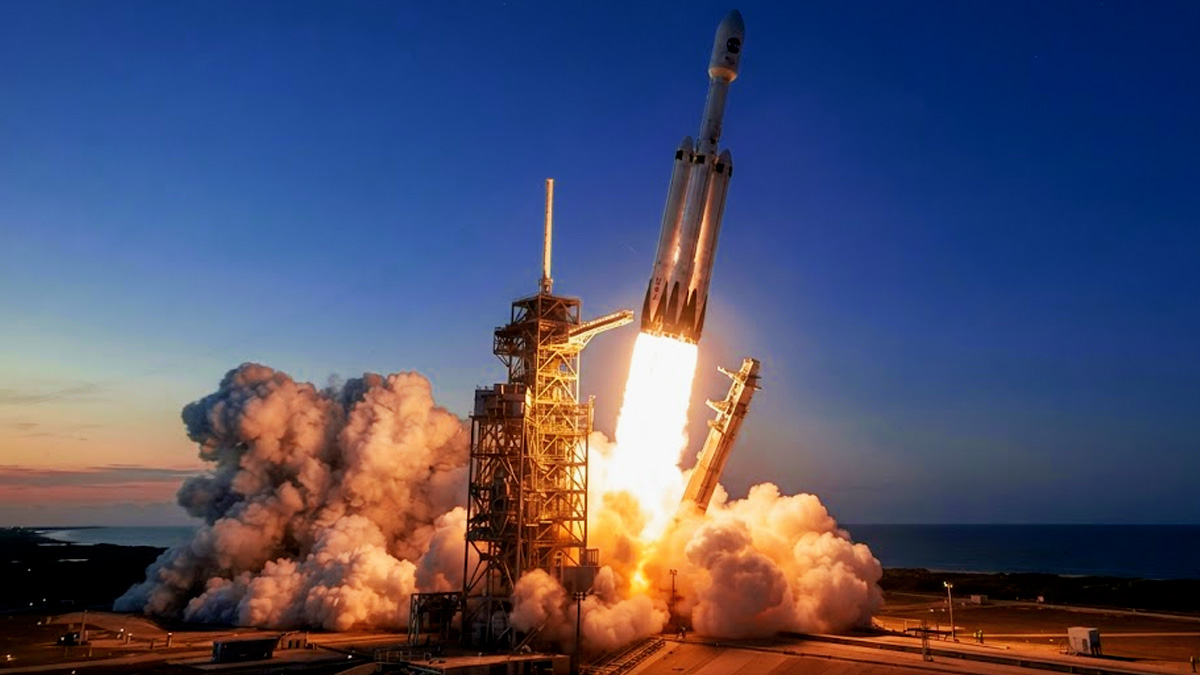
Image related to Discarded SpaceX Falcon 9 Rocket on Collision Course With the Moon. (Photo: Metro Daily Reporter)
Table of Contents
SpaceX rocket will crash into the Moon
A discarded upper stage of a SpaceX Falcon 9 rocket, which has been drifting in space for over a year, is on a collision course with the Moon. The impact is predicted to occur on August 5, 2026, at approximately 06:35 UTC . The event, which is entirely accidental, will see the rocket stage crash into the lunar surface at a speed of about 5,400 mph (8,700 km/h), or seven times the speed of sound, near the prominent Einstein Crater . While this particular piece of space junk poses no immediate threat, the event presents a rare scientific opportunity and highlights the growing challenge of space debris management as lunar exploration intensifies .
The Origin of the Space Debris
The object in question is the upper stage of a Falcon 9 rocket, officially cataloged as 2025-010D . It was launched on January 15, 2025, on a mission to deliver two private lunar landers: Firefly Aerospace's Blue Ghost and the Japanese company ispace's Hakuto-R Mission 2 (also called Resilience) .
After successfully propelling the payloads towards the Moon, the upper stage was discarded and remained in orbit, drifting through the Earth-Moon system . While one of its payloads, the Blue Ghost lander, achieved a successful lunar touchdown, the ispace lander ultimately crashed . The rocket stage itself was left to wander, its trajectory largely influenced by the gravity of the Earth, Moon, and Sun, as well as the subtle but cumulative pressure of sunlight .
Predicted Impact Location and Time
The predicted impact point is on the sunlit western limb of the Moon, near the rim of Einstein Crater . Space object tracker Bill Gray, who first flagged the potential collision, has developed software used by astronomers to track near-Earth objects . Based on over 1,000 observations of the stage's orbit, he has pinpointed the impact time to within seconds of 06:35 UTC on August 5 .
For observers in the Americas, this translates to the early hours of the morning: 2:34 a.m. ET / 1:34 a.m. CT / 12:34 a.m. MT / 11:34 p.m. PT on August 4 . The best viewing locations will be in the eastern portions of the United States and Canada, and much of South America, where the Moon will be highest in the sky .
Scientific Significance and Observation Plans
This accidental collision is being treated as a valuable "natural experiment." Unlike natural meteoroid impacts, which are unpredictable, this event is well-characterized and monitored, providing a unique opportunity for calibration . The primary goal is to study the dynamics of the impact and its resulting ejecta plume, which could help assess the risk of debris impacts for future astronauts and infrastructure on the Moon .
The impact is expected to pack the energy equivalent of about three tons of TNT, carving out a new crater approximately 27 meters (90 feet) wide and 5 meters (16 feet) deep . While the brief impact flash will likely be too dim to see from Earth, the plume of ejected dust and rock could rise tens of kilometers into space and remain visible to telescopes for several minutes .
"This is a rare chance to open up ejecta-plume science and calibrate those models against a real event, which matters for every future thing we deliver to the moon," said William Jo, a researcher from the University of Texas, Austin . Benjamin Fernando of Los Alamos National Laboratory adds, "Part of the reason for our interest in this event is to figure out how much of a hazard debris impacts pose to future astronauts" .
Scientists are urging both professional and amateur astronomers to observe the impact . Several orbiters around the Moon, including NASA's Lunar Reconnaissance Orbiter (LRO) and South Korea's Danuri spacecraft, will also be used to capture before-and-after images of the crash site for analysis .
Context of Intentional and Accidental Crashes
This event will be the second known accidental crash of a rocket stage into the Moon. In 2022, a section of a Chinese rocket created two craters on the lunar far side . However, controlled crashes have a history in lunar science. During the Apollo program, NASA deliberately crashed rocket sections and modules into the Moon to conduct seismic experiments. In 2009, NASA intentionally sent the LCROSS spacecraft and its rocket stage into a permanently shadowed crater near the lunar south pole to search for water ice .
The upcoming Falcon 9 impact, while unplanned, will occur on the near side of the Moon, making it more accessible for immediate Earth-based observation than the 2022 Chinese rocket event. As retired astrophysicist Jonathan McDowell notes, "In a future where there are long-term bases on the moon, similar impacts would be an issue and we need not to leave rocket stages in chaotic orbits of this kind" .

Related Articles